.png?width=158&height=34&name=Autarco%20logo%20(1).png)
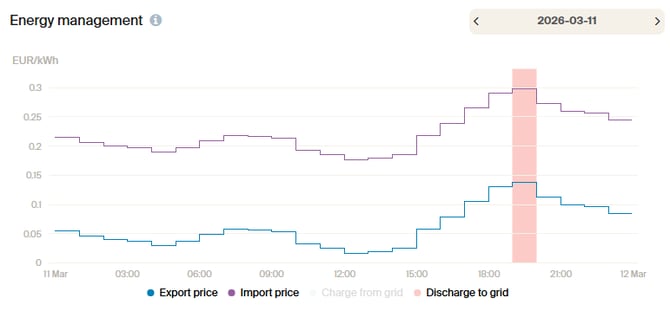
In the MyAutarco Energy Management Chart, you may occasionally see a red shaded area. This indicates a "Force Discharge" event. The Smart Charging algorithm has determined that exporting stored battery energy to the grid at this specific time is the most financially beneficial action for your system.
Problem description
Users may notice their battery discharging to the grid even when there is no high household demand, or they may wonder why a red block has appeared in their energy management overview.
Description of the solution
The Smart Charging model forecasts your energy needs until the next sunrise. If it predicts that you have more energy in the battery than you will realistically consume, it will schedule a Force Discharge. The goal is to "clean out" the remaining State of Charge (SoC) during the highest price moment of the day to maximize your revenue.
This typically happens for several reasons:
-
Excess Capacity: Your battery capacity is larger than your typical household consumption for that night.
-
Seasonal Effects: During summer, the time between sunset and sunrise is short, requiring less stored energy.
-
Optimization for the Next Cycle: To gain the most benefit, the algorithm wants the battery to be empty (or at its minimum SoC) just as the next charging cycle (from PV or cheap grid power) is about to begin.
-
Price Maximization: By discharging during the highest price peak, you get the maximum possible return for "free" stored energy.
How it works during the Force Discharge:
-
Fixed Discharge Power: The inverter is commanded to discharge the battery at a set power level.
-
Interaction with PV: This command is applied specifically to the battery. If there is simultaneous PV production, the house will use the battery power first, and any PV production on top of that will also be used or exported. The battery discharge power remains constant regardless of solar output.
-
Goal: This mode ensures your system is "ready" (empty) for the next day's production, ensuring no solar energy is wasted because the battery was still half-full.