.png?width=158&height=34&name=Autarco%20logo%20(1).png)
This article explains how Smart Charging operates within the Autarco Energy Management System via Cloud EMS.
At its core, Smart Charging is a centralised optimisation process. Autarco servers calculate the most financially optimal battery charging and discharging schedule based on market prices, system forecasts and technical constraints. The inverter then executes this schedule locally.
Although the optimisation logic is advanced, the underlying principle is straightforward. Below, we first explain the overall workflow and then describe the input data, optimisation logic and fallback behaviour.
High-level working principle
Smart Charging follows a three-step process.
First, optimisation takes place on Autarco servers. Electricity price data for the region where the system is installed is continuously evaluated. Combined with consumption and production forecasts and system parameters, this results in a financially optimal battery schedule.
Next, the calculated charging and discharging plan is sent to the inverter as a time-based schedule.
Finally, the inverter executes the schedule locally and autonomously, without requiring continuous real-time communication with the servers.
 What happens if communication is lost?
If communication between the inverter and Autarco servers is temporarily interrupted, the inverter continues executing the last known schedule. This ensures stable and predictable behaviour and prevents uncontrolled charging or discharging.
Input data used by smart charging
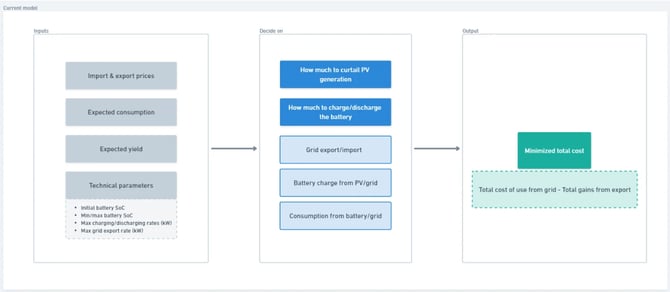
Before optimisation can take place, the system collects several inputs describing both market conditions and system behaviour.
Import and export prices
Import and export prices are based on EPEX SPOT market prices for the applicable region. These prices are adjusted with financial components such as energy taxes, supplier margins and export compensation or fees. Together, they define the economic value of importing or exporting electricity at any given moment.
Expected consumption
The system uses a forecast of household electricity usage to estimate how much energy is required for self-consumption. This allows the EMS controller to reserve sufficient battery capacity for household needs and avoid unnecessary imports during expensive hours.
Expected PV yield
A forecast of solar production is generated based on system characteristics and weather data. This helps estimate how much energy will be produced and how much surplus may be available for storage or export. As a result, the battery can be charged when solar energy is expected and storage capacity is available.
Technical system parameters
Technical inputs include the current battery state of charge, battery capacity and charge or discharge limits, and inverter and grid constraints. These parameters ensure that the calculated schedule is technically feasible and safe to execute.
Optimization decisions
Once all inputs are collected, the Smart Charging algorithm determines how energy should flow throughout the day.
It evaluates whether PV production needs to be curtailed due to grid constraints or negative prices. It decides when and at what rate the battery should charge or discharge. It determines when electricity should be imported from or exported to the grid. It also selects the most suitable energy source for consumption, whether from the battery or directly from the grid, and whether the battery should be charged from PV or from the grid.
All decisions are made with the objective of maximising financial outcome while respecting technical and grid limitations.
Creating and executing the optimal plan
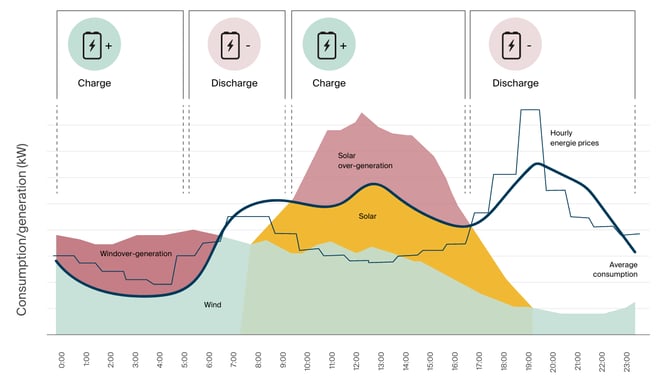
The result of the optimisation process is a time-based energy plan that defines battery charging and discharging moments, grid import and export behaviour, and PV usage or curtailment.
If the plan is relatively simple, it can be sent directly to the inverter as a complete schedule. If the plan includes many charging and discharging events, it may be divided into segments and queued on the server, with commands delivered to the inverter at the appropriate times.
The inverter then follows the received plan locally.
Fallback behaviour
In some cases, not all input data may be available.
If one or more inputs are missing, except for price data, Smart Charging automatically switches to a price-only optimisation mode. In this situation, decisions are based solely on import and export prices, and consumption and production forecasts are not used. Optimisation remains active, but with reduced precision.
This fallback mechanism ensures the system continues operating in a predictable and economically reasonable manner, even when data availability is limited.
Summary
Smart Charging is centrally optimised and locally executed. Autarco servers calculate the most financially optimal battery schedule using price data, forecasts and technical parameters. The inverter executes this schedule autonomously and safely.
Temporary communication loss does not interrupt operation, as the last known plan remains active. If certain inputs are unavailable, the system falls back to price-only optimisation.
By combining intelligent optimisation with local execution, Smart Charging enables batteries to move beyond simple self-consumption and actively respond to changing market and system conditions.