.png?width=158&height=34&name=Autarco%20logo%20(1).png)
This article explains how the Autarco EMS controller enables smart charging, unbalance market trading, and peak shaving to optimize energy usage, improve grid stability, and unlock new value streams.
Smart charging on Autarco EMS controller
Smart charging allows your electric vehicle charging stations to dynamically adjust their energy consumption based on real-time usage, solar production, and site constraints. With the EMS controller, you can easily enable and configure smart charging to optimize energy efficiency and prevent overloading.
What is Smart Charging?
Smart charging on the EMS platform ensures:
-
Efficient use of available power.
-
Priority-based load balancing between multiple EV chargers.
-
Integration with solar production and battery storage.
-
Avoidance of main fuse overloads.
Unbalance market trading
What is unbalance (Imbalance) market trading?
When a Balance Responsible Party (BRP) doesn’t match its forecasted supply versus consumption, it incurs imbalance charges. To avoid this, BRPs and their Aggregators can buy or sell “flexibility” in short notice imbalance markets, typically in 15-minute slots.
Key Players & Roles
-
BRP: Responsible for balancing its portfolio to avoid imbalances.
-
Aggregator: Pools flexibility from assets (e.g., EV chargers, solar, storage) to offer deviations from a baseline.
-
TSO: Uses imbalance trading to maintain overall grid balance.
-
DSO: May also trade flexibility to prevent local congestion.
How It Works (Simplified)
-
Baseline Forecast: Aggregator sends a “D‑prognosis” (expected consumption/generation without flexibility) for each 15‑min interval
-
Flex Offer: An aggregator offers flexibility upward or downward from its portfolio to the BRP/TSO/DSO.
-
Activation & Measurement: If accepted, assets adapt in real time.
-
Settlement: Actual deviation is measured, settled at imbalance prices, and integrated into imbalance calculations
Why It Matters for Dealers
-
You can enable customers’ assets (e.g., smart chargers, DERs) to actively participate in these markets.
-
Adds value to installations by helping BRPs/TSOs/DSOs avoid imbalance or congestion costs.
-
Supports grid stability while creating new revenue streams via flexibility services.
In Short
Unbalance market trading is a fast-acting, compensation-based approach. Aggregators offer real-time deviations from forecasted energy use, which are then activated and settled in 15-minute imbalance markets. This helps balance the grid and reduces costly forecast errors.
To get this configured, reach out to the aggregator of your choice to check compatibility and how they can facilitate the steering. Some provide integrated solutions, while others may require custom adaptation.
Understanding Peak Shaving with Battery Storage
Peak shaving is a powerful feature of battery storage systems designed to extend the capacity of your existing grid connection.
The concept is simple:
-
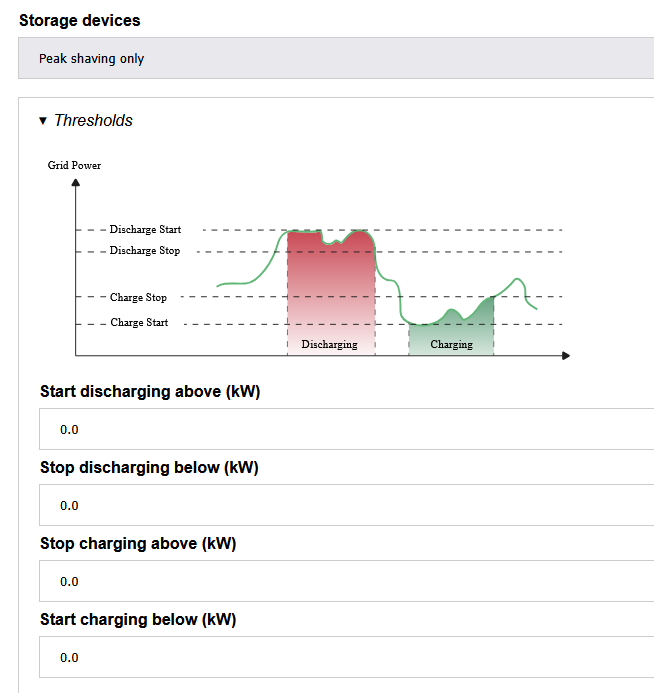
When the grid load exceeds a predefined upper threshold, the battery begins discharging to reduce the load on the grid.
-
Once the grid load drops below that threshold, the battery stops discharging.
-
If the grid load falls below a lower threshold, the system starts charging the battery again until the load rises back above that level.
By discharging and charging the battery at strategic moments, the system helps reduce or “shave” the peaks in energy usage. This makes your energy consumption more efficient and helps prevent overloads on your grid connection.