.png?width=158&height=34&name=Autarco%20logo%20(1).png)
It is a common misconception that steering an energy system in a “smart” way always requires an EMS Controller.
In this article, we explain in which use cases the internal logic of the Autarco inverter is sufficient for the required energy management functionality.
Note: This article is based on the latest Autarco models.
For older systems, please contact Autarco Sales or Support to verify compatibility.
Before you start
All EMS-related features require consumption meter data, either:
-
via a smart meter connected to the inverter, or
-
via a smart meter connected to the EMS Controller.
EMS feature overview
While an EMS can provide many advanced functions, this article focuses on the most common ones:
-
Power limitation
-
Export limitation
-
Peak shaving
-
Self-consumption
-
Time-of-use optimisation (tariff-based)
-
Remote monitoring
-
Generator support
-
Response to negative export prices (dynamic contracts)
-
Smart charging (EPEX / dynamic prices)
-
Grid services (imbalance markets)
-
EV charge management
-
Dynamic load management
-
Mixing device brands
Feature categories
These features can be divided into three main groups:
1. No EMS needed
Many Autarco hybrid inverters have EMS capabilities built-in.
You can configure these directly via Digital O&M (Helios Web) or the InstallerApp.
Additionally, Dyness battery cabinets include internal EMS functionality that can be configured in the Dyness platform (coming to Helios soon).
Note: All Dyness cabinets must be installed with the Acrel ADL smart meter (included with the cabinet) to enable this functionality.
Suitable setups for internal EMS logic:
-
Standalone Autarco hybrid inverter
-
Up to 6 Autarco hybrid inverters (latest generation) in parallel:
MH-MIII, LH-MII, LQH, XLH, OH series - Autarco hybrid inverter used as a retrofit with any 3rd party on-grid inverter
-
Standalone Dyness DH100F, DH200F, DH200Y
-
Multiple Dyness cabinets in parallel (same cabinet type only)
Important: Mixing any of the above setups requires an Autarco EMS Controller to ensure correct operation.
2. Cloud EMS
Some features are available via NPR in Helios (on request) or through the EMS Controller.
3. EMS required
Certain advanced features require an EMS to function correctly.
These are listed in the final section of this article.
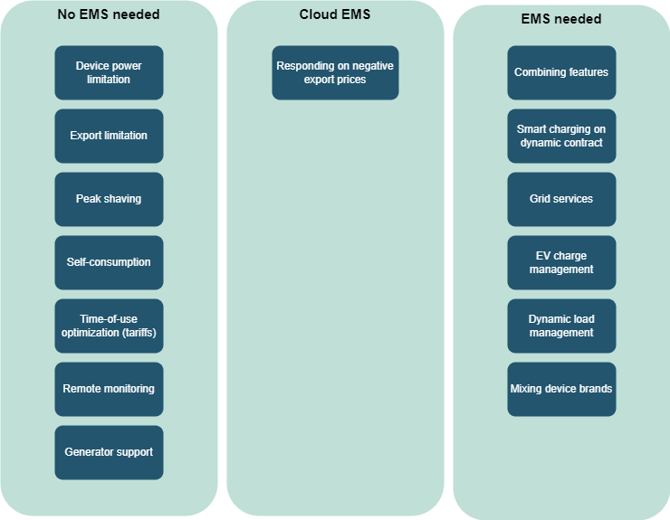
Note: The diagram (if applicable) shows typical scenarios, actual setups may vary.
For details, contact Support (existing systems) or Sales (future opportunities).
Feature supported internally in devices
Power limitation
All our latest devices have the capability to limit their power generation.
This power level can be set statically in the inverter or via Digital O&M. This feature does not require a meter or an EMS.
Supported for:
-
On-grid inverters
-
Hybrid inverters
-
PELD
-
Cabinet batteries
Export limitation
For locations where export is not allowed, the Zero Export feature is the perfect solution.
Our inverters have the capability to limit themselves via the (internal) PELD function.
This makes the device limit production until there is no export.
Does not require EMS
Supported for: On-grid inverters, hybrid inverters, PELD, and cabinet batteries
Requires: External smart meter installation. (for details, take a look here)
Peak shaving
This feature allows the user to provide extra power to the load whenever it’s higher than the maximum grid import power.
It is designed for customers dealing with grid congestion or unable to meet consumption demand from the grid.
When setting up this feature, two data points must be defined:
-
Max grid import power
-
Peak shaving SOC
Max grid import power defines the maximum power the user wants to import from the grid.
Whenever the device detects that the load is higher than the max allowed import power + PV power at that moment, it will start discharging the battery to ensure the consumption demand is met.
Peak shaving SOC defines the state of charge that the battery must reserve for peak shaving.
It should be set based on the expected power and duration of the demand peak.
Like the battery reserve function, the device will always try to charge the battery to the peak shaving SOC as soon as possible.
Note: For this feature to work effectively, the setting Allow charge from the grid is recommended to be always ON.
Example:
A peak of 80 kW for 1 hour is expected for the load, with a 3 × 80 A grid connection used together with S2.XLH50000 + BF100.
Assuming the worst-case scenario (no PV, modules covered in snow, etc.) and a max grid import of 50 kW, the battery should supply 30 kW for 1 hour.
This means the peak shaving SOC should be set to at least 30% (30% of the 100 kWh capacity of BF100 when fully charged).
Does not require EMS
Supported for:
-
Hybrid inverters (LQH, XLH, and OH series)
-
Battery cabinets (smart meter connected to the cabinet required – Acrel ADL400, delivered with the cabinet)
Self-consumption
This global feature can be set in parallel with other functions.
It defines the priority of energy supply.
To maximize self-consumption, the inverter will charge the battery whenever consumption demand is met.
Only when the consumption is met and the battery is fully charged will the energy be sent back to the grid.
Does not require EMS
Supported for:
-
All Autarco hybrid inverters
-
Battery cabinets (smart meter connected to the cabinet required – Acrel ADL400)
Grid trading
This global feature sets the opposite priority to self-consumption.
When grid trading is enabled, energy export is prioritized over battery charging once consumption demand is met.
Does not require EMS
Supported for all Autarco hybrid inverters
Time schedule
This feature allows the user to choose multiple charge and discharge time slots.
During these slots, the battery will be forced to charge or discharge until it reaches the set SOC point, the over-discharge SOC, or the slot ends.
It is ideal for systems with stable weekly profiles or markets with low price volatility.
Available hybrid inverters:
MH, MH-MII, LH, LH-MII, LQH, XLH, OH
(4 charge and 4 discharge time slots, with SOC setpoints)
Available cabinets:
DH100F, DH200F, DH200Y
(4 charge and 4 discharge time slots, with separate settings for each day of the week)
Remote monitoring
With Autarco communication sticks, remote monitoring is fully supported using the internal device capabilities.
Does not require EMS
Cabinets can be remotely monitored via an external portal.
For cabinet data in MyAutarco, an EMS controller is required.
Generator support
Some Autarco hybrid inverter models have a generator port that allows automatic generator start/stop based on the battery’s SOC level.
Does not require EMS
Supported for:
-
Hybrid inverters
-
LH-MII series (communication port only)
-
LQH, XLH, and OH series (separate AC generator port)
-
Battery reserve
This feature is designed for customers who want backup energy during an off-grid state.
It allows setting a battery reserve SOC, which the inverter will always maintain as a minimum charge level.
During normal (on-grid) operation, the battery operates between 100% and the reserve SOC.
The reserved SOC is only used when the inverter detects an off-grid condition, ensuring energy availability during outages.
Note: For optimal performance, enable Allow charge from the grid.
EMS features supported via cloud
Responding to negative export prices with a dynamic contract
The devices we supply do not have insight into dynamic electricity prices.
Therefore, they cannot perform this EMS feature internally.
However, we offer a cloud-based solution where internal export limitation can be switched automatically without the need for a local EMS controller.
Requirements:
-
Smart meter installed
-
Two-way communication stick
-
EMS required when combined with other features
Supported for:
-
On-grid inverters
-
Hybrid inverters
-
PELD (only supported via Cloud NPR)
EMS-only features
The following features are only available when using an EMS.
Smart charging based on EPEX / dynamic contract prices
If the energy system must respond to EPEX market or dynamic contract prices, this cannot be done internally by the inverter or battery cabinet.
To enable this feature, an EMS is required to retrieve real-time price data and control the connected devices accordingly.
Requires an EMS
Grid services (imbalance markets)
Controlling devices based on grid service signals. For example, to participate in imbalance markets, is only possible via an EMS.
Internal device capabilities do not support this functionality.
Requires an EMS
(or an external party that integrates with the Autarco API)
EV charge management
EV charging stations are not directly supported within device-level functionality.
To integrate EV charging with other energy devices, an EMS is required for communication and coordination.
Requires an EMS
Dynamic load management
If the system requires specific loads to be enabled or disabled based on grid connection measurements, an EMS is required.
Autarco inverters do not have internal relay or signaling capabilities for this function.
Requires an EMS
Combining features
When multiple EMS functions are combined, an EMS is generally required to ensure the features do not interfere with each other.
This ensures correct prioritization and coordination across devices.
Requires an EMS
Mixing device brands
Different brands often use proprietary communication protocols and cannot directly interface with one another.
If you want multiple brands of devices to operate together, an EMS is required to coordinate communication and optimize system performance.
Requires an EMS